
*The Trenches *Latest *The Cast *About *Donate
***
The United States Is Terminal: E Pluribus
Unum That Never Was
The Upcoming Balkanization of America

America stands on the precipice of a reckoning—a
descent into chaos is imminent—one that will shock even those who witnessed the
brutal unraveling of Yugoslavia. Some of the parallels to Yugoslavia are
unsettling; others are horrifying. The United States was built on a myth of
unity—a melting‑pot where disparate peoples could find common ground. That myth
has been eroded from the inside out. The tragedy of the former Yugoslavia serves
as a chilling counterpoint to any naive optimism about national unity. Despite
sharing an almost identical Slavic cultural bedrock—a common language with
barely perceptible dialectical variations, and an identical racial component—the
region descended into a brutal conflict that birthed new terms like “ethnic
cleansing” to describe the horrors unleashed. The differences among the peoples
there were—and are—truly minor, largely superficial, yet they were weaponized by
political opportunists and exploited by simmering resentments. It underscores a
fundamental truth: shared heritage is not a guarantee of peaceful coexistence;
it can be twisted and manipulated to justify unspeakable acts.
The United States, in stark contrast, presents a
landscape riddled with far more visible fault lines. Unlike the Balkan states
which ultimately found themselves within the broader democratic sphere, the
fragmentation of America promises something far more chaotic—something that
would make a Hollywood screenwriter giddy. This isn’t a warning; it’s an
observation. A diagnosis. The trajectory is clear: fragmentation. Balkanization.
Not neat regions with catchy names—no “Midwestern Agricultural Federation.”
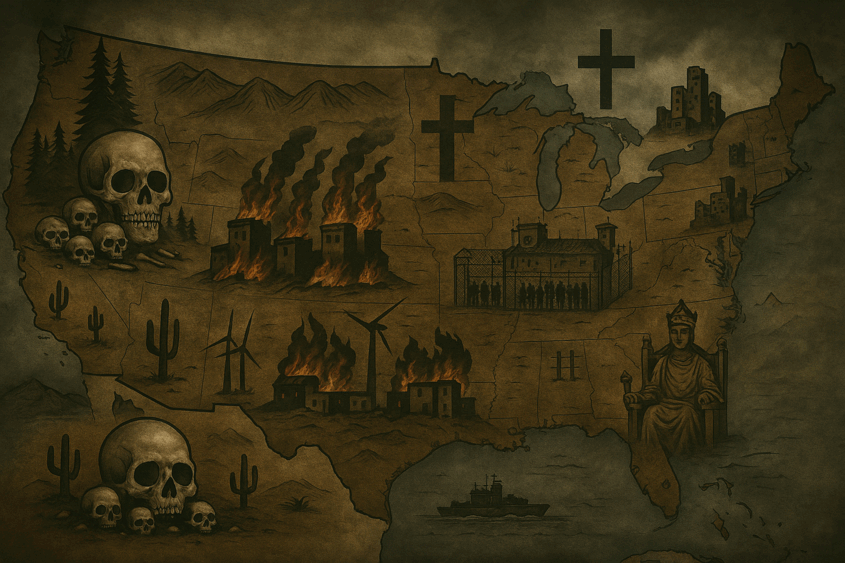
Something far more chaotic. In the fictional media and filmmaking of recent
years, balkanization of America is seen as being broken apart into half a dozen,
at most, large regions. No, there will be hundreds of shards. The end result
will be a patchwork of regions with wildly contrasting and conflicting
ideologies, all vying for dominance in a landscape stripped bare of national
authority. Republics and micro‑nations built on delusion, from coast to coast; a
smattering of outright neo‑feudal monarchies with an Americana flavor; Southern
Christo‑Judeo‑fascist fundamentalist fiefdoms where heretics are dealt with in
ways that would make Islamic fundamentalists wince; coastal Maoist enclaves
clinging to outdated revolutionary ideologies and their sisterly counterparts
with a 21st‑century take on Bolshevik communes; Libertarian “paradises” where
slavery is re‑legalized and anything goes; nuclear‑backed self‑styled military
dictatorships. In between? Lawless zones where the strong prey on the weak—zones
run on the basis of warlordism, regions that would make a Liberian warlord with
cannibal tendencies absolutely thrilled—a Hollywood script coming to life.
Impossible you say? Unlike the relatively contained
conflicts of the Balkans, where shared identity was fractured along lines of
religion or regional affiliation, the divisions in America are vastly deeper,
varied, and have none of the benefits the doomed Yugoslavs had. Half a century
of communist rule had flattened the economic sphere so no one was truly
wealthy—or for that matter, living on the bare margins—largely eliminating the
economic strains of haves‑versus‑have‑nots that brought many empires to their
knees. Most if not all Yugoslavs had a roof over their head, but no more than
that, America has no such cushion—a nation where wealth concentration has
reached levels unseen since the Gilded Age and homelessness has reached epidemic
proportions. Yugoslavia had only one racial component versus every race under
the sun represented in the American tapestry of today. There was no one historic
underclass in the Balkan peninsula; everyone was oppressor and oppressed at some
point in a region’s 3,000‑year history. Looking at America, the legacy of
slavery and the one‑sided nature of oppression is inescapable. The religious
component of former Yugoslavia and its successor states was such that the Slavic
Muslim population fermented and consumed their own Slivovic (plum brandy) by the
tanker‑load—and still does—while various Christian denominations limited
churchgoing to an occasional wedding, if that. On the other hand, in America the
extreme religious components—who are becoming mainstream day‑by‑day—sometimes
rival the worst of ideological ISIS spew, only with a Judeo‑Christian paint job.
For every division, for every fracture, and for every difference Yugoslavs had
among themselves, America and Americans have them by the thousandfold; and in
most extreme cases, extremes that would make the ultra‑nationalists and war
criminals of early‑1990s Yugoslavia shake their heads in wonder and horror.

The signs…
But before we get into more Mad Maxian
prognostications, let’s start looking for the
signs. Let’s start with economics. First and foremost
there are the relentless cycles of economic shocks that have crippled any chance
for sustained recovery: the dot‑com bust of 2000–2001, followed by the 2008
financial crisis and a decade of unrestricted quantitative easing in its
aftermath, followed by the bumbling response to the COVID‑19 pandemic and the
further inflationary period that came after. Each shock left deep scars before
the next blow landed. It’s as if the nation is perpetually drowning, struggling
to surface between waves of manufactured crises and systemic failures. This
constant instability has fostered a climate of anxiety and resentment, fueling
the very divisions it exacerbates. The national debt now exceeds $34 trillion
and shows no sign of plateauing. Each new fiscal year brings another round of
“must‑pass” spending bills that are passed not through consensus but through a
series of brinkmanship maneuvers that leave the Treasury perpetually on the
edge. When citizens stop believing that the government can deliver basic
services—education, health, safety—the social contract begins to fray. The
result is an economy that cannot sustain its own promises.
Outside the borders, for sixty years the U.S. dollar
served as the default reserve currency, granting America an “exorbitant
privilege” of cheap financing. That dominance is eroding. Enter
de‑dollarization: nations all over are negotiating bilateral trade agreements in
currencies other than the dollar, while sovereign wealth funds diversify out of
U.S. Treasury holdings. The dollar’s decline will not happen overnight, but each
incremental loss of confidence chips away at the United States’ capacity to fund
its deficits and sustain its current standard of living. Add to that a new
“aristocracy” of tech‑billionaires and corporate oligarchs coexisting with a
growing underclass that sees the American Dream as a distant memory.
What else is a distant memory? Ability to “make
stuff.” A sign perhaps to
dwarf all others. A simple overpass or bridge in the United States can take a
decade—or even decades—from conception to completion—a timeline dictated by
litigation, review, and political bargaining, which is fancy for “corruption,”
dysfunctional as opposed to functional kind (see China). Speaking of which, by
contrast, China has demonstrated the capacity to design, finance, and construct
multi‑million‑person urban districts (“cities”) within as short as 18 months.
While stateside homelessness is rife, homebuilding moves at snail’s pace and is
subject to turbulent economics of 2020s America; owning a home is increasingly
akin to winning the lottery. High‑speed rail projects that once promised
national connectivity now sit dormant after years of planning. The electrical
network suffers from chronic underinvestment; outages are becoming routine
during peak demand periods. When the nation’s arteries cannot be repaired in a
timely manner, economic growth stalls, rot sets in, and the countdown begins.
Another sign?
COVID‑19 pandemic. It was marketed as an unprecedented crisis, yet it should
have been a manageable event for a nation of America’s stature and supposed
abilities. Instead, the pandemic served as a brutal mask‑off moment—pun
intended—a stark revelation of America's profound institutional weakness. While
nations around the world mobilized to combat the virus, America descended into
partisan bickering and denialism. The response wasn’t merely inadequate; it was
a performance of societal collapse, exposing a deep‑seated inability to act
collectively in the face of an existential threat. Pandemics’ true significance
lies in what it revealed about American governance: federal response was
fragmented; states pursued divergent policies, resulting in a patchwork of
lockdowns that varied wildly from one county to the next. It’s a humbling
reality that nations with far fewer resources—countries often dismissed as “less
developed”—managed the crisis with greater order, professionalism, and
ultimately more success. Many Americans asked themselves what would have
happened in a case of actual bio‑terrorism—or god forbid—a biological attack by
a peer nation?
And speaking of death and destruction, pathogens and
institutional inadequacies, there is the military. Perhaps the greatest and most
visible sign of decline of
them all. The undisputed symbol of American power now stands as a shadow of its
former self—a cho‑cho train that could but never would. One train that hasn’t
reached a destination in 80 years, or won a war as it were (and even then the
Soviets did the heavy lifting). America projects power abroad while neglecting
decay at home—a dangerous delusion that masks vulnerabilities.
What is the old MIC up to you ask? The usual. Programs
once heralded as “next‑generation” now sit in endless review cycles; budgets are
allocated not to building new platforms but to patching legacy systems that have
outlived their useful life and were outdated 50 years ago. There is the
cancellation of vital programs, dwindling recruitment numbers, and an
increasingly desperate reliance on conflicts that yield diminishing returns:
Iraq, Afghanistan, Syria, Iran, and now protracted proxy wars across Africa.
Each intervention drains resources while failing to produce decisive
outcomes—revealing a nation clinging to a myth of dominance all the while China
quietly builds a modern military machine, often surpassing American capabilities
in both quantity and quality. It is obvious the Chinese are building a military
with toys meant to win wars—not line the pockets of retired generals sitting on
boards of various MIC conglomerates.
China’s rapid investment in missile tech, unmanned
combat aerial drones, and integrated networked warfare is eroding America’s
quantitative edge. On paper, the United States still fields the world’s most
technologically advanced armed forces, but reality tells a starkly different
story. America's once‑vaunted military (was it ever?) has become a grotesque
parody of its former self.
A sign
often overlooked is the nearly three decades of War on Terror. There was no
greater accelerant than the disillusionment stemming from the failures of
conflicts borne from that political theology, politely called neoconservatism.
The mantra of the early days of the Bush administration—“We fight them over
there, so we won’t have to fight them here”—is now tragically morphing into a
nightmarish yet unspoken slogan, subconsciously understood by all: “We will
fight each other at home.” It’s not United States of America versus the Taliban
in Afghanistan anymore. The future sequel to this might be Arkansas, maybe
Indiana, or perhaps most likely and geographically most appropriately
Michigan—using its One‑True‑God militias to subdue Chicago’s Maoist partisan
revolutionaries in the very near future.
We couldn’t convert the so‑called “Islamic hordes”
overseas to our way of doing business—as many neocon commentators would often
say during the waning years of the WoT era. Those same commentators are now, on
various social‑media platforms, openly pontificating that perhaps, just perhaps,
those pesky liberals in their urban enclaves can be taught some manners via some
asymmetrical assimilation—a phrase coined for the purpose. On the left, in those
very same urban centers, there are open calls to embrace China; calls for
withholding tax revenue sent to various Federal entities; intimations of
drafting laws that would effectively embargo neighboring right‑leaning states.
In short, the failure of the War on Terror has not
simply been a foreign‑policy misadventure; it has become a catalyst for internal
radicalization at home. The very institutions that once projected American power
abroad have turned inward. The War on Terror didn't end; it metastasized.
Internalized. That initial promise of external conflict diverting internal
strife proved hollow; instead, the anxieties and frustrations born from those
failed interventions are being redirected inward, fueling the very divisions we
were supposedly trying to avoid.
The irony is bitter; the outcome inevitable.
And that brings us back to what can and will be. All
these trends, all these signs,
point toward a society increasingly reminiscent of late‑apartheid South Africa—a
stark inequality coexists with rampant crime and an entrenched sense of
grievance across racial and class lines. The ultimate result? South Africa:
North American Edition. This is unfortunately the most optimistic scenario of
them all. The inevitable reality is Balkanization. It is unavoidable and the
most likely outcome.
Hope?
Balkanization, at home? Can’t happen you say? I am
sure the Soviets said the same thing. So did the Brits before them, as their
massive global empire melted away in mere decades. Examples go on and on. Let’s
take Texas of today as an example. It has cultivated an almost monarchical
identity rooted in “Texan exceptionalism,” where the governorship is
increasingly seen in aristocratic terms, while portions of California and New
York have adopted policies that read like platforms of far‑left European
social‑democratic and niche Communist parties—parties that have long abandoned
some of those policies themselves. In short, America is breaking apart into
smaller and smaller, increasingly ideologically different regions—vastly so,
where every demographic difference is weaponized rather than merely tolerated,
which in turn creates even more fractures, fragmenting these regions into even
smaller, even more radicalized entities seeking even deeper ideological
purities.
Truly a scenario that would make a Hollywood writers’
room stand in awe. A scenario we might live long enough to experience in all its
Balkanized glory. What new horrific terms will be invented this time around?
E Pluribus Unum, indeed.